Earlier this week, I had read in the NZ Herald of Shane Jones reportedly trumpeting the prospect of a nuclear energy policy being considered for adoption by NZ First at its Convention this weekend.
For several reasons, I found this somewhat surprising.
First and most obviously, because that would seem to contrast with the "Founding Principle", still up on the Party's website currently, declaring: "New Zealander's [sic] desire for a non-nuclear future will be respected."
But second, because if we look overseas - moves in favour of nuclear power often seem to be tacitly (or even expressly) opposed by fossil fuel interests; who then either marshal or manufacture mouthpieces and media-grabs to propel their favoured outcome, accordingly.
Which, if you've noticed, is usually (at least, for other matters) what Shane Jones seems to be found doing for said industry here - an effort that's less 'subtly seeded astro-turf' and more 'one-man mangrove swamp with a megaphone' and accompanying dinner reservations.
So why would Jones all-of-a-sudden come out with a statement that New Zealand First is seemingly looking to put nuclear power here on the agenda?
It's true that Jones has previously sought to push for what we might charitably describe as 'novel' remedification for our nation's electricity difficulty - with the present "supercritical" geothermal drilling initiative (which an industry expert had characterized as "a technology that's unproven internationally, let alone nationally") being exhibit A.
Yet nuclear power is something fairly 'sui generis' when it comes to New Zealand politics and the public perspective. It has a 'magic' to it ('black', rather than 'green') which renders it customarily well outside the bounds of comfort for many ... and with a particular emphasis against it from amidst our environmental movements.
For Jones to proffer a seemingly pro-nuclear generation policy smacks of (at least) one of two things.
Option A - he's engaging in his apparent favourite sport, of Green-baiting; not simply in terms of the instant-uproar from such a quarter which adopting such a policy would induce (should NZ First choose to do so) - but also through seeking to force the pro-environmental voices of our politics into openly and overtly disavowing a technology being presented as of significant utility in countering climate change.
That is - a gambit aimed at snaring his frog-defending opponents into coming across as empty 'virtue signallers' upon a major issue from within their own home turf.
Considering his ongoing grandstanding antagonism about Jacinda - you can just imagine the twist he'd put on 'climate change as our generation's nuclear free moment' for this. (I'm not saying any of the aforementioned as elements which I'd personally agree with - only that it would be the sort of rhetorical invective which would play 'well' for some of his intended audience)
And/Or
Option B - he's preparing the ground (no pun initially intended) for something which could be potentially of more interest for his surreptitious taste in dinner partners. Something along the lines of opening up an opportunity for commercial mining of the uranium (and thorium) deposits to be found on the South Island's West Coast.
Which, curiously, are featured in an NZ Petroleum & Minerals 'Prospectivity Report' for the region, apparently created on the 25th of June this year - the brochure in question advising prospective exploration and/or mining permit applicants as to the existence of "radiometric data show[ing] a dominance of Th[orium] and U[ranium] in some sand deposits along the coast". 

That there exist radioactive mineral deposits in the area is not exactly new information; it's been acknowledged in GNS reports in the past, certainly.
However, there's an obvious difference between their being mentioned within scientific survey cataloguing (and featuring, in the case of the 2019 GNS 'Mineral Commodity Report', stern disclaimer that for uranium, "there will be no production in the near future due to New Zealand's [relevant regulation] which specifically does not allow prospecting, exploration and mining of the primary uranium and thorium minerals") ... and their being put forward amidst the (to quote the material) "significant exploration and mining opportunities" which NZPAM wishes to advertise as open to pursue.
That said, per current iteration for the 'Minerals Programme (Minerals Programme for Minerals (Excluding Petroleum)' ( 1.6 (3) ) : "Applications for permits for prospecting for, exploring for, and mining uranium and thorium minerals will ordinarily be declined".
While this would still allow the Minister (guess who) to be able to make extra-ordinary approvals within this area (or, at least, try to) - rather than uranium mining, the main thing it would open up in practice would be an immediate fusillade of Judicial Review applications instead.
Hence, if he were serious about making such a thing happen, the Minister would need to push some small alteration for the relevant regulations (in this case, the aforementioned non-petroleum Minerals Programme - which, per s5(c) of the Crown Minerals Act 1991, he's responsible for preparing, and per s16(1) can propose changes to) so as to properly secure permissibility.
Presumably, whilst loudly insisting upon a public purpose for which he did so.
Something along the lines of making possible a certain party's 'bold' new proposal for provisioning our power market, perhaps.
Friday, September 5, 2025
GET THIS MAN A BREATH-MINT - On Shane Jones' Proffered Fissile Probing
Monday, June 23, 2025
Auditing The Government's Police Numbers Strategy
An audit of 1022 police recruits that went through training between January 2024 and April 2025 reveals 128 did so despite being unable to pass a "basic literacy assessment", in addition to dozens of other irregularities (the one that got the headline was the 36 that failed psychometric testing but were waived through anyway).
Now, I am a simple man. And it seems to me that this haste on the part of the Government to try and fill 500 pairs of police boots by November is going to cost our state money in the long run - because quite a lot of modern policing is, in fact, comprised of activities for which one needs to be ... in a word - "literate".
Submitting evidence to court? Filing charges? These are things which hinge upon the police officers in question being able to read and write to a decent official standard. It is not hard to find record of cases dismissed significantly because somebody on the Police end of things didn't get things right in these essential areas.
What does that work out as in practical terms? The very real potential for Justice not just 'delayed' but outright 'denied'. And no doubt a heap of 'compensatory' work being carried out 'behind the scenes' by Non-Sworn staff working for Police to try and tidy things up that shouldn't have become 'loose ends' in the first place.
It all costs time, money, and most importantly - people's faith in the institution and our system.
I would additionally proffer another trenchant insight upon matters Blue and Unwieldy (that's National, not necessarily Policing).
Namely, that we're in this mess in no small part because our Government refuses to pay our Police a fair amount - leading to a long-running saga of police unable to afford to continue in the job ... or, more aptly, often unable to continue in the job on this side of the Tasman.
Hence this piece from a little over a year ago featuring "more than three hundred" NZ police officers applying to patch over to Queensland. Which, for those whose 'basic numeracy' may be on par with some of these recruits by the sound of it ... is a little over half the target for 'New Cops' that our Government is aiming towards by November.
To phrase it bluntly - we are paying the price, quite literally, in terms of needing to massively upscale our recruitment and training of potential new cops (who may or may not actually be of a decent quality - no matter what the government tries to claim contra-wise), because we keep haemorrhaging more experienced police over to Australia in pursuit of livable wages, or simply seeing them exit the vocation entirely.
And - needless to say - those more experienced officers who've already been in the job a number of years are worth considerably more than fresh recruits who're yet to have much in the way of actual, practical experience outside a training environment.
It would seem to me that the way to retain quality officers - who've already been painstakingly selected, screened, and then both trained and in receipt of several years' on-the-job experience - would be to LISTEN TO OUR POLICE ASSOCIATION and sort out the pay for the police officers we've already got, rather than attempting to supplement / replace them with cheaper (on paper, and in the very short term) new recruits instead.
I would be very surprised if it turned out that that approach would not be a better use of money than the $226 million which National (and NZ First) have wanted to put toward their apparent preferred approach of recruiting and training more 'fresh' officers to try and bolster numbers.
Sunday, May 4, 2025
On Trump's 'Victory Day' Revisions
This is ... a bold set of claims.
And not least because I would have assumed VJ Day in August would have made for a more logical 'Victory Day for World War II' than VE Day in May (although I suppose it's the immediately impending occasion with the Russians' famous annual Victory Parade in Moscow which has caught the American President's imagination here).
Nobody should doubt that the Americans made very significant contribution to the successful outcome of the Second World War; and they have every right to justifiable pride when it comes to both that and their efforts in the latter part of the First.
But I do not think it wise to attempt to set a sort of 'quantum of contribution' with a bid to try and out-compete - or, indeed, view it as a competition - other countries for 'credit' in the manner Trump's statement seems to oblige.
"Strength", "Bravery", and "Military Brilliance" are not uniform values across all years and all men, formations, and fronts. There is no mention made for "material" - in the sense of contribution made to others, whether Commonwealth or Soviet Union, through Lend-Lease.
And as applies "did far more" - one rubric might be manpower contribution and lives given, where the Soviet Union would be orders of magnitude larger in its scope than the Americans. In terms of a 'per capita' approach, there may be smaller groupings of man whose contribution was nevertheless higher in proportion than that of larger powers, whilst remaining lower in absolute terms. There are many ways to 'stack' it, and many elements to include if one seeks to come to some form of overarching 'credit quotient' for the war's ultimate result.
But, again, that is not a sensible way to seek to examine the conflicts in question. They are not 'scoreboards' for future generations to squabble upon like video-game match outcomes.
And it is absolutely unnecessary to proffer that America "did more than any other Country [sic], by far" in order to justify - as I say - a deserved pride in that which America did contribute, or to underpin appropriate commemorations oriented thusly towards.
What I would suggest is that the appropriate paradigm for it is a different meaning to Trump's "We won both Wars".
Yes. We - as in, the Allies (and this term has somewhat different scopes of inclusion for each War ... ) - won both Wars.
It was a team effort.
And, I might add, a team effort by previous generations to either myself or Trump (born a year after the latter conflict's conclusion); which has tended to mean I've felt rather uneasy about utilizing that first person plural pronoun with reference to the victors and sacrificers of those downright apocalyptic conflagrations.
It would feel entirely incorrect of me to seek to claim credit for the actions and the honorifics of those far greater men and women who have now largely (if not yet quite completely) left this earth for us to inherit and to give thanks for.
Although going via his tone in various communications over the years, I'm not entirely sure how much Trump might have assented towards that ethos.
I also do wonder if "Celebrating" is the apt verb for something like a commemoration to the end of World War One.
"Commemoration" has always seemed, to me, to be the more useful (and emotionally apt) approach.
Wednesday, February 5, 2025
As His Fans Scream Victory, Trump Backs Down
There's something ... odd going on.
I've seen a bunch of comments around the place from pro-Trump Americans (and apparently wishing-to-pretend-they're-Americans) this afternoon which have basically been, to summarize: "Trump threatened Canada with Tariffs, CANADA FOLDED!"
And therefore, Trump holding off on imposing his much-vaunted tariffs as the fruit of a victory won by wielding them as a negotiation tactic (well, "submission-demanding tactic" would be more how those fans are countenancing it, but anyway).
Except here's the thing. The Canadian policy which they're pointing to as what Trump "won" with this week's tariff threats ... was already announced a month and a half ago.
It's true that Trudeau had re-mentioned some of the headline details of it (like the $1.3 billion dollar funding boost for Canada's border security) in the course of his speech in reply to Trump's tariff stick-waving, so I suppose I can see why it might have looked like it was in reaction to Trump's threat.
Although during the course of said speech, Trudeau also mentioned a rather extensive suite of retaliatory tariff etc. measures which Canada would be implementing if America went through with Trump's announced approach.
In other words - the only thing which actually changed as a result of Trump's recent announcement he was going to impose tariffs on Canada, is Trudeau declaring that Canada would respond in kind.
But because, apparently, 'object permanence' is a bit of a difficult thing out there ... a policy-set which was already announced in mid-December, is grasped by these pro-Trump commenters as having been swiftly congealed in early February in specific response to Trump's tariff declaration late last week.
And therefore, Trump saying actually he's going to not go through with his imposition of tariffs (for at least the next month - conveniently aligned with the time-scale announced by Trudeau for Canada's rollout of 'retaliatory' tariffs ... Trudeau had said that his government were going to give Canadian business several weeks to adapt and find alternate suppliers etc., hence why not simply emplacing their own tariffs immediately in response to Trump's) ... gets purported as proof of victory.
To say that again: Trump backs off on imposing tariffs on Canada following Canada saying it would respond in kind, and because Canada's PM also re-mentions in his speech a policy his government had already come out with last year, this is presented as the direct consequence to Trump's tariff imposition, so 'Trump Victory'.
Rather than, say, Trump swiftly backing away from doing something, immediately following Canada showing an intent to retaliate significantly if he actually went ahead and implemented it.
Now, I'm not saying that there was no causal relationship between Trump making remarks last year toward Canada and Canada's December announcement of a funding increase for its border security etc. (although considering the sheer size of Canada's borders both on land and sea, I do rather wonder how much of an increase that $1.3 billion actually works out as).
However, considering Trump's declared tariff imposition toward Canada last week happened over a month after that Canadian announcement ... Trump rescinding (or, at least, "Pausing" for "at least thirty days" the actual implementation for) his tariffs on Canada cannot have been in response to what was already put forward within same.
Phrased more succinctly - Canada didn't 'back down' to Trump this week.
It did the opposite.
It declared it was prepared to 'push back' directly - and Trump abandoned his attack (whilst phrasing it as a 'pause' for ... long enough to be conveniently forgotten about, and for some other big flashpoint to have come to the fore for him to claim a victory on instead).
But because people really do rather like to 'feel like [they're] winning', his enthusiastic online support-base (and, no doubt, their epochal predecessors in more traditional media) are jubilantly presenting things as if Trump's tariff imposition a few days ago actually succeeded.
And yes, yes I suppose it did.
It succeeded in getting Trudeau to make a speech (he's good at speeches - it was a pretty decent one, The Rev. Rolinson was watching it last night).
Some "win".
Friday, September 27, 2024
Yeah? Well What're You Doing About It! - National's Bemusing Attempted Distraction On CGT Claim
I read in my newspaper yesterday afternoon that Luxon had had a rather ... odd comment in reply to ANZ's CEO saying that a capital gains tax on investment properties was, in principle, fair.
What did he say?
"She’s more than welcome to enter the political domain, [...] But the point I'd make is that the big Australian banks make a lot of money off the New Zealand public, and maybe taking more money isn’t the right way forward."
The way Luxon probably intended this to come across was something like "taking money from New Zealanders Bad" .. in the sense that his government collecting tax from its citizenry is apparently somehow comparable to profits levied by private sector enterprise, and that higher profits are ... ok, so maybe it doesn't actually work very well as an analogy.
But here's the thing.
Luxon using this as his response to Watson (the ANZ CEO aforementioned) upon the comment with relation to CGT 'fairness' is revealing.
Effectively, when somebody brings up a point with some logic for it (in this case - somebody who literally wrote their dissertation on tax remarking that while they're not hugely enthused about it, it's "fair" to tax investment property as investment in property) , National doesn't really have an answer.
What they've got instead is whataboutery and insults.
Nicola Willis' contribution was similarly glib:
"If she's really worried about the wellbeing of New Zealanders, then there's a lot the bank could be doing".
Ok, but you guys - Luxon, Wills et co. - you're the Government.
If you're genuinely of the opinion that our banking sector is not acting in concordance with the "wellbeing of New Zealanders", and is (as is generally agreed) taking rather eye-watering profits at our literal, direct expense ...
... then why not actually do something about it?
New Zealanders gave these guys (rightly or wrongly) the power to govern.
That means much more than being 'theoretically aware' of a problem but only deigning to decree via press-encounter that a bank (or, indeed, the entire banking sector) 'should' do something better ... when one of their CEOs happens to mildly embarrass you in a media cycle.
Friday, October 13, 2023
On NZ First's Impending Return To Parliament - Both In The Mirror & Through The Looking-Glass
There's a quip often (and probably erroneously) attributed to Mark Twain which goes something like "History doesn't repeat itself - but it often rhymes."
It's something I've occasionally had in my head as concerns NZ political history and various then-current events ... but rarely so pointedly than the present situation concerning my old party, New Zealand First.
Which, for those assumedly living under a rock or up a river somewhere in the South Island trout-fishing and trying to hide away from the media ...
... is that having been turfed out of Parliament three years prior following their not-terrible term as part of a Labour-led Government, they're now polling somewhere in the 5-6% range and looking like they'll return.
You know - rather like 2011.
Except it isn't.
And before we go any further upon all of that score, I'd like to take a moment to do that most 21st century of things and ... clarify my pronouns going forward.
You'll hear me say "We" a fair bit in the course of this piece. That's in reference to the Party I was part of, joined up in 2009, served on its Board of Directors for nearly half a decade (including through the 2011 Campaign), and was finally sent into exile from circa 2017 following my public statements of dissatisfaction as to how certain elements therein were conspiring for a long-term 'drift to the right'.
I say "We" there - and I think, as applies commenting upon the 2011 Campaign, that I've earned that right.
At other times, you'll hear me say "They". That, of course, refers to the Party ... after I was out of it (oddly enough, only in one sense to the term - very much clean-and-sober otherwise), and most especially as applies its present 'heel-turn' phase from late 2020 onward.
I still voted for them in 2017 - and do believe that I made the right call going hard for them in the years prior to that, because we got a pretty decent Government from 2017-2020 thanks to NZF's coalition decision; but I would be highly, highly unlikely to do so again.
And with that heaped helping of DISCLAIMER out of the way ... on with the show!
Partially, this article has been motivated via the ... peculiar pronouncement made by NZ First to its membership over the weekend that it isn't "backed by big business", but instead "relies on our grassroots supporters for financial support".
Because yeah - once upon a time, that was absolutely true. And it makes it all the more remarkable how we (as we were at that point) managed to pull off what we did circa 2011 - amidst a condition of media virtual blackout, no less!
And that's why I must confess that I find this current chicanery to be so ... bad taste, because it almost feels like the 'Spirit of 2011' is being worn like a most macabre puppet. It's got all the overt signaling of an 'out-group' political insurgency against some unrepresentative 'elite' ... as funded by and working for the interests of some of New Zealand's wealthiest men.
But let's go back to the (first) campaign in question, and take a look at some facts therein.
In 2011, we campaigned off the smell of an oily rag (a dangerous thing to do with that many cigarettes smoldering at once!)
The total spend for election expenses (advertising etc.) was $144,570.61, with a broadcasting allocation from the Electoral Commission of $102,000. As you can see, the $48,534 from 551 donors which the Party recorded in 2011 (as well as for the periods 2010 & 2009) was pretty sorely needed and actively utilized.
To put this in context - David Farrar's analysis (which uses the ~$155k figure which NZF had earlier submitted for its 2011 return - this was later amended downward by over ten thousand dollars in an amended filing) had NZF spending $1.06 per vote.
Getting 6.59% as a result
For further context, here's Farrar's full table for 2011:
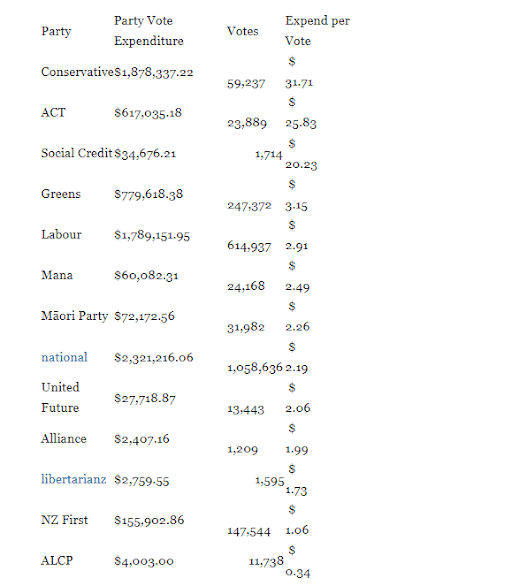
Which, as you can see, has NZF being incredibly 'efficient' when it comes to dollars-into-votes.
You know how that happens? When you're actually campaigning hard because you can't afford to do it the rich way.
Going into 2023, meanwhile, we find quite a different story. Namely - 398,597.83 of donations & loans [from 122 donors; mostly in the 5k to 15k range] for 2022; 307,125 [from 63 donors] for 2021; and $600,000 from 11 donors declared for 2023 thus far [plus a very large estate bequest from former candidate, Hugh Barr].
So, I'll rephrase that - they've gone from getting around less than $50,000 in donations over 3 years total and fighting an election on that [and much more than that - but by this I mean manpower & enthusiasm not dollars] ... through to hauling in 6x, 8x, 12x that [26x all up?] from an evidently much smaller donor pool.
Something which, looking forward from our perspective back there in 2011, would have seemed rather surprising, I have to say - considering all the rich-listers usually better-known for backing ACT who appear to have suddenly experienced manic bursts of patriotism over the past twelve months and thus opened their wallets for Winston et co.
Although then again we also distinctly recall Shane Jones bringing long-time backers, Talleys, to the party from 2017 onward [$26,950 from 2017-2019 via the NZ First Foundation; $10,000 to Jones' own Whangarei campaign in 2017] - which appears to have netted the fisheries company a decent return as applies the long-running advocacy (and/or policy road-blocking) from the self-described "industry apostle".
And, for that matter, one Troy Bowker who'd bestowed (via property company Caniwi Capital Partners) some $24,150 for 2019 - and who would probably have been rather pleased when NZ First performed an abrupt volte-face on supporting the Government's Covid rent-relief proposal mid-2020 following what had appeared to be their earlier support.
But let's get back to our core theme here.
That being NZ First's 2023 efforts as ironic echo of 2011's insurgent gains.
It's now a 'big money' campaign. In multiple senses to the term.
Why do I mention that?
Because if we run back to 2011, that Farrar figure of $1.06 per vote ... and 6.59% as an eventual result (with a pervasive clime of media blackout, I might add!) ; this contrasts rather heavily with NZF circa 2023 having spent most of the past year at between 2% and 4.5% - only in the last few weeks cracking the 5% threshold.
This is in spite of:
i) the fact that they've managed to have a significant run of advertisements in the likes of the NZ Herald (seriously, for weeks upon weeks now, literally every day I open my newspaper - physical newspaper, because I'm an old man like that - I am confronted with advertising for NZ First therein; I am sure it's much the same across other parts of the country);
ii) what I anticipate to be a similarly ... pervasive / expansive suite of other advertising expenditure via other mediums (a family member had related seeing a full-on billboard in prime position out there somewhere, for instance - not a hoarding, a billboard; although I accept that that's anecdotal evidence);
iii) the party (and Winston specifically) has been in receipt of a much more favourable media environment - by which, I should hasten to clarify, I don't mean that media outlets and journalists are giving him an easy time when talking about him or the party. They're often not. But more that they're talking about him and the party at all - and have been doing so for some time.
And as applies that last point - in politics, that maxim of Oscar Wilde's (aptly enough, given our subject, from 'The Picture of Dorian Grey') that "There is only one thing in the world worse than being talked about, and that is not being talked about", is very much cross-applicable to politics.
Now, of course, I don't know how much money NZF has spent on its campaign this year thus far (or, for that matter, its efforts in the past two years falling outside the count period) - but as I say, I don't think they're putting all them hundreds of thousands they're getting per year into playing the Auckland property market.
And while, admittedly, it's certainly possible that they'll wind up with an Election Night result which is notably above where they're currently polling - say, in the 7% range; on the basis of where they're at now, it looks like they've spent a metric trucktonne (that's a technical unit of measurement) more cash (in a more amenable media environment) now to get not as far as we did 12 years ago.
There are, of course, a few likely reasons for this (not-quite-yet-a-) result.
One of which, somebody will say, is under-polling. Yet I don't know how apt that might actually be. After all - the last poll before the 2020 Election (a Reid Research) actually overpolled NZ First (3.5% in the poll - versus 2.6% as the actual result), whilst the two previous Colmar-Bruntons, at 2.4% and 2.6% (the latter closest to the Election) were pretty much bang-on.
Instead, I suspect there's a substantive reasoning to it:
I don't think they've really recovered from their losses / alienation of support from the 2017 campaign onward.
And I should, perhaps, clarify that by explaining what I'm referring to there.
The 2017 campaign saw a marked tac 'rightwards' and loud noises about Maori issues ... a risky move considering i) the Party'd gotten back in in 2011 and then built its support further in 2014, through left-wing or Labour-protest-/tactical-vote support; ii) had strong Maori support (seriously - as a brief illustrative exemplar, up until 2017 some of the strongest-performing electorates for party-vote for NZ First percentage-wise have tended to be the Maori Seats ... even despite the Party not standing candidates therein).
I gather that the objective with all of this was to actively court National / right-wing support; on the presumption that National was at its high-water mark, and that National sloughing off support would either lead to a bolstering for ACT / the New Conservatives (the latter .. at a much more microscopic scale), or could lead to NZ First's gain.
This isn't merely speculation upon my part. I was actually told this quite directly - with a literal illustration being given in the form of the Party's 2017 'branding' and outreach materials. These featuring a new style of logo with chevrons pointing 'to the right', and in many cases with a pointedly 'blue sky' backdrop prominent thereupon. Subtle.
The trouble being the presumption that the Party's membership and more especially voter-following was effectively 'locked in', despite not inconsiderable chunks of it having come from Labour / (anti-National) protest vote over the two elections previous. Or, at the very least, that they'd be able to 'trade' any 'left-ish' support for the anticipated gains from National (and, of course, the Conservative Party - having imploded - with its 3.97% showing in 2014).
As for how they went with it ... well, ok, in fairness, I do distinctly recall them picking up a whole gaggle of ex-(New)Cons etc. into the membership. But it was, at best, treading water - and really, their vote went from 8.66% in 2014 through to 7.2% in 2017 [that being, in actual vote terms, 208,300 => 186,706 ... even despite turnout going up], so in reality they lost votes.
And then proceeded to compound upon this in each of the 2017 coalition negotiations and then subsequently the 2020 campaign itself.
The former, obviously, was where NZ First ultimately sided with Labour (which I do believe to have been the correct move - albeit handled escalatingly poorly as the term wore on) ... thus annoying the hell out of the very same National / (New) Con etc. support they'd just sought to sacrifice their more left-ish saliency for.
The latter, meanwhile, was that curious episode wherein instead of playing the 'Elder Statesman' who'd enabled (and was integral to) probably the most popular government in living memory at the time ... Winston wound up endeavouring to run against the Government he was still serving in - winning over few, and losing further again.
Personally, I find these recurrent twists and contortions rather eyebrow-raising - although probably not for the overtly obvious reason.
Rather, it's because I well remember a conversation with Winston in early 2011 when we were headed down from Auckland into the Waikato for a day's campaigning. We'd been talking about - from memory - the newfangled discipline of 'political marketing', and its seeming insistence that parties go out of their way to chop and change (even wholesale reinvent themselves) in order to chase some no-doubt focus-group identified 'key demographic'.
Winston was (to my mind quite rightly) dismissive of the whole concept. To his mind - at least at the time - that was the opposite of a good idea. And in order to illustrate the essential problem as to the proposition, he invoked that well-known fable of the man, the boy, and the donkey.
For those unaware - ... you know what, I'll just quote the damn thing.
"A man and his son were once going with their donkey to market. As they were walking along by his side a countryman passed them and said, "You fools, what is a donkey for but to ride upon?" So the man put the boy on the donkey, and they went on their way.
But soon they passed a group of men, one of whom said, "See that lazy youngster, he lets his father walk while he rides."
So the man ordered his boy to get off, and got on himself. But they hadn't gone far when they passed two women, one of whom said to the other, "Shame on that lazy lout to let his poor little son trudge along."
Well, the man didn't know what to do, but at last he took his boy up before him on the donkey. By this time they had come to the town, and the passersby began to jeer and point at them. The man stopped and asked what they were scoffing at.
The men said, "Aren't you ashamed of yourself for overloading that poor donkey of yours -- you and your hulking son?"
The man and boy got off and tried to think what to do. They thought and they thought, until at last they cut down a pole, tied the donkey's feet to it, and raised the pole and the donkey to their shoulders. They went along amid the laughter of all who met them until they came to a bridge, when the donkey, getting one of his feet loose, kicked out and caused the boy to drop his end of the pole. In the struggle the donkey fell over the bridge, and his forefeet being tied together, he was drowned.
Try to please everyone, and you will please no one."
As it happens, I was, of course, already in agreement with Winston's point all the way back there in early 2011 - with no need for him to then provide us with a tangible multi-year demonstration running from circa 2017 to near the present in order to really drive the point home.
Although that said - it's not exactly accurate to say that NZ First has ended up 'pleasing no-one'. It just took awhile to find its 'new crowd'.
Specifically, about four months. That being the approximate temporal distance between this statement from Winston on the 4th of October, 2021, wherein he demands a pretty serious (over-)extension of the vaccine mandate concept ...
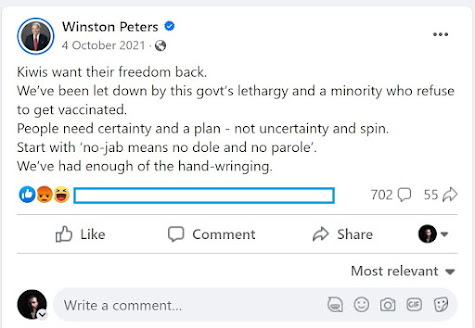
... and Winston's visit some 141 days later on February 22nd last year to Thorndon's answer to Glastonbury centered on Parliament's front lawn.
As it happened, that was also the point at which the occupation protest really got ugly. Not, you understand, due to Winston's unmasked appearance - but rather due to the bewildering spectacle of a protester speeding his car the wrong way down Molesworth Street into a crowd in a bid to hit a row of police.
That was a day before Winston's visit, and came hot on the heels (and/or other protester anatomy) of attempted-bombardments of police by protesters literally flinging human excrement at them.
All things considered, it was not perhaps the most obvious place I'd have anticipated a party which has often presented itself as pretty actively concerned about law and order issues to be going fishing for photo-ops at.
Not least given that the gentleman who'd accompanied Winston upon that occasion, former NZF MP (and generally pretty sharp guy) Darroch Ball (more recently a co-leader of the Sensible Sentencing Trust) had previously felt strongly enough against assaults on first responders that he'd successfully introduced a Member's Bill to make the more serious of these a standalone offence under the Crimes Act (and, it should be noted, extend the already-existing coverage under the Summary Offences Act for assaults on police, traffic, and prison officers to also encompass both medical and fire service first responder personnel as well).
And while there are, no doubt, a great many further things which could be said about the ... piquant alignment of New Zealand's anti-vax and/or anti-mandate and/or anti-coherent-understanding-as-to-international-jurisprudence-pertaining-toward-crimes-against-humanity-carried-out-in-the-1940s movement around Winston et co - that isn't the purpose to this article.
Besides which, I'm sure Andrea Vance did a much better job in her piece upon the subject published in the Sunday Star Times a few weeks earlier.
I would, however, observe that this, too, is a case of one of those curious 'rhyming' leitmotifs for New Zealand First.
In that in 2011 - it was, indeed, a voice for a severality of sectors of Kiwi society who felt they'd been marginalized via the rather radical socioeconomic 'experimentation' which had been foisted upon us for the preceding then-twenty seven years of onrushing Neoliberalism.
Hence, you understand, why it was significantly so antipathic toward National.
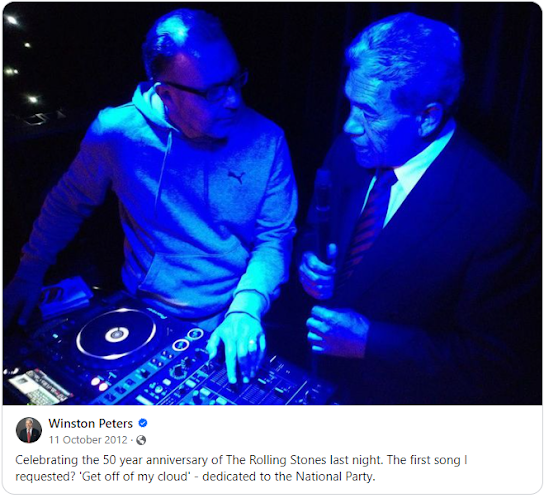
Whereas come 2023, we find that there's another array of persons who insist that they've been marginalized by Government (specifically, the one the party they're now lining up behind was actively party to ... and which then sought to criticize for not going far enough in various measures which would have marginalized the anti-vax and anti-mandate sorts further) ... oh, and the whole thing's backed by a billionaire and is very explicitly proclaiming it intends to empower the National (and ACT, it seems) party back into Government.
That is what I mean by a 'rhyme' rather than a mere 'repeat' - it is, as it were, a 'mirror image'. That's why everything is seemingly exactly the wrong way around.
I contemplated opening this piece with that famous dictum of Marx - that "Hegel remarks somewhere that all great world-historic facts and personages appear, so to speak, twice. He forgot to add: the first time as tragedy, the second time as farce."
Yet I truly do not believe that New Zealand First's insurgent return to Parliament the first time around was a tragedy - although certainly, certain of the events and choices made in the decade-and-then-some since that occurrence could most certainly bear such a sobriquet descriptor.
Indeed, it reminds one of the passage from Dostoyevsky's The Brothers Karamazov (nothing should be read into the fact the chapter is, itself, entitled 'The Old Buffoon'):
"Above all, don't lie to yourself. The man who lies to himself and listens to his own lie comes to such a pass that he cannot distinguish the truth within him, or around him, and so loses all respect for himself and for others. And having no respect he ceases to love [...] The man who lies to himself can be more easily offended than anyone. You know it is sometimes very pleasant to take offence, isn't it? A man may know that nobody has insulted him, but that he has invented the insult for himself, has lied and exaggerated to make it picturesque, has caught at a word and made a mountain out of a molehill -- he knows that himself, yet he will be the first to take offence, and will revel in his resentment till he feels great pleasure in it, and so pass to genuine vindictiveness."
But again we digress, and with it heading toward dawn on the day afore the Election, I really should hurry up and get this thing published.
General Koechlin-Schwartz reportedly remarked to Patton that the poorer the quality of infantry, the more it needed artillery ... and that the American infantry needed all the artillery they could get .
NZF's big-spend bombardment should seem to be covering for just such a gap.
In closing, I should like to quote a great man, a politician who - whilst flawed - I genuinely admired, and was proud to serve under.
He observed the following:
"No one pays a million dollars to a political party without asking for something. Members should ask Michael Fay about that. He paid the National Party a million dollars, did he not? And this was the deal: “You bail me out from the BNZ and you get me into State asset sales, and I will get a return of three to one. I will put on that million dollars for you, and I will get, by the freedom of policies, $300 for every dollar I put down.” That is National; that is its record.
Those ignoramuses can scream and shout, but I know about that. I was there, and I saw what was done. I saw how National was prepared to compromise some hard-working lady down in Gore or some poor guy in Kaitāia, who were making cakes, organising hoedowns, and picking up membership for the National Party. But National was prepared to put all those people aside for the sake of the few or the very few—or, as Roosevelt put it, those over-mighty subjects."
His name was Winston Peters.
I can't help but wonder what has happened to him since.
Friday, March 24, 2023
A Cost To The City - On Mayor Brown's Most Recent Curious Initiative
It's a curious thing watching Mayor Brown make efforts at 'cost-saving'.
In the name of this slogantastic endeavour, he's recently managed to propel the Auckland Council to withdraw from Local Government NZ.
He claims, apparently, that this would save the city roughly $640,000. Which might sound a fair bit of money - up until one considers that his target for savings is in the realm of roughly three hundred million dollars.
Councilor Richard Hills, by contrast, suggests that withdrawing from LGNZ would instead spare us only $370,000 a year, made up of a population-based membership fee ($350k) and contribution to the annual LGNZ conference ($20k).
Perhaps more importantly, he also points to a somewhat larger figure as constituting the monetary value of the benefits to Auckland from LGNZ membership that we'd be foregoing via withdrawal. LGNZ itself, perhaps predictably, concurs - suggesting we've just thrown away a million dollars a year in positive financial returns to our membership.
However it's not my purpose to get into that dimension of things. Others are, no doubt, going to present the relevant Numbers on such a score over the coming days.
Rather, I thought I'd Do My Part for Auckland by seeking to help the Mayor in his cost-cutting agenda.
Since a figure somewhere between $370k and $640k per annum is apparently a saving worth pursuing in such a manner ... we have no doubt that the Mayor will be positively thrilled that I've identified a miscreant who's already managed to cost the Council and the struggling ratepayer well more than that over a span of less than six months.
An article run by Stuff back in November had Brown staking out his intent to use far more ratepayer money than his predecessors in staffing his own office. Here's the quote:
"Brown’s approach is in stark contrast to his famously frugal predecessor Phil Goff, who in the year to July 2021, spent only $1.8m of the near $5.2m available – frugality his staff once promoted to the media.
But it appears Brown has a different approach.
“Unlike my predecessor, I intend to make full use of the powers and resources available to me to do what the law demands,” Brown said."
A little over two weeks later, the same outlet reported upon some of those "full uses" in action. Various of these hires didn't serve out their full terms and so didn't cost quite so eye-wateringly much, but it nevertheless makes for ... an interesting running total via comparison to the LGNZ participation fees Brown is so vehemently opposed to.
To whit - Matthew Hooton on a $135,000 contract for six months; Tim Hurdle and Jacinda Lean at $280,000 for the pair to act as chief of staff and deputy for six months (of which, they served seven weeks); ex-NZF MP, Jenny Marcroft, at $37,500 for eleven weeks as a 'Government and External Relations advisor' (and oh boy does he seem to need the 'advising'); and last, but most certainly not least, his legal advisor - Max Hardy, formerly of Meredith Connell - making a similarly seamless transition from Brown's campaign team to his Mayoral Office, being first an interim ... something at roughly $5,000 a week (so $260,000 annually), before taking over as interim chief of staff. A role in which the Herald reports Hardy had received $17,250 for three weeks' work (for a yearly salary of $299,000).
It's assumedly in that former position that he managed to tot up a "substantial" portion of the $123,000 ($61,500 a month) worth of legal services which the Mayor received from Meredith Connell in the two months since his election, entirely separate to and over and above the Council's own contracted use of the firm.
Insofar as it matters, we might also incorporate the $58,305 which he spent hiring PR firm Topham Guerin for five weeks to help him handle the aftermath of the Anniversary Weekend floods and their ensuing cleanup. Few would disagree that our Mayor has had a bit of a communication problem, and that expert assistance would be justified - although with $12,000 of that going on a swift-draw campaign which appears to have produced a grand total of one logo and three shirts (two of which may have, ultimately, been ratepayer funded - Desley Simpson reportedly having bought hers off the council after taking it for its thus far only public airing, on February 7), and another $7300 for a further "brand" ... well, a nebulous chunk of the remaining $39,005 seems a potentially rather high price to pay for the admittedly no doubt difficult task of managing to get the Mayor in front of a camera and sounding reasonably cogent upon this issue.
Now before we go any further, I feel I need to clarify something here.
I'm not for a moment seeking to suggest that the Mayor's Office should not have quality, competent staff - and be willing and able to pay to attract good talent to fill relevant vacancies therein.
Quite the contrary.
He evidently needs help - and there's no shame, as the man at the center of the city, in being prepared to put your hand up to bring in people able to enable you to do what needs to be done. (Although one can, perhaps, wonder aloud whether certain of those appointments really were the 'best' that our money could buy - at least, for the prices offered. There's one in particular in the above enumerations which, upon basis of observed past track record, I'm rather less than enthused at).
Rather, my issue here is with both the priorities on show, and what it seemingly demonstrates about what our Mayor's approach actually is. Once we cut through the (at times rather considerable) rhetoric and bluster, I mean.
Consider it this way - whether we take the $370,000 figure or the $640,000 figure (and leaving out, for the moment, what positive returns from the fee's payment Auckland gets as the result), those are relatively small numbers.
If it were THAT necessary to make immediate and dire savings across the board to the point that a few hundred thousand dollars really would make all the difference, then figures of that kind could be not-all-that-uneasily found to be slashed out of the Mayor's own $5.2 million discretionary budget.
Perhaps the list of savings, adding up to well over a million dollars a year, that his predecessor, Phil Goff, managed to squeeze out of the Mayoral budget not so long ago could serve as some rudimentary form of inspiration.
And, as a case in point for What Brown Might Have Done Differently, even something as simple as actually using the Council's pre-standing agreement with Meredith Connell (and in-house counsel and other advisors in the relevant area) rather than duplicating services by hiring a flash former partner to report directly to the Mayor etc. etc. would have saved somewhere around a third of the lower figure through to a fifth of the higher one.
So phrased another way, I really don't think this is actually about the money here.
Instead, it's about sending a message. Two, in fact.
The first one is obvious - it's to that pert portion of his voter-base who elected him to i) stick it to 'The Bureaucracy' ii) do likewise toward the general direction of Wellington.
A move like this, which can be branded as Mayor Brown extricating (Brown-Exiting?) Auckland from a 'bureaucracy' that's umbilically tethered to 'Wellington' (whatever the relevant facts of the matter) ... is an unqualified win according to these optics. If you go in for that sort of thing, of course.
But the second one is perhaps less so.
In his live-tweeting of the Council meeting yesterday afternoon, Tim Murphy quoted Brown as proffering the rationale that withdrawal from LGNZ was desirable because "staying on our own it forces [ministers] to come and see us".
Now, as it happens, Brown's been on about this before. Not long after his election, it came out that Brown's office had effectively sought to strong-arm the PM (at that point in time, Jacinda Ardern) into basically that.
That is to say, they'd generated a press release to be distributed following Brown's first meeting with Ardern on the 20th of October, declaring that she'd agreed to a "group of senior ministers and the mayor and senior councillors" coming together as a working group ... with who, exactly, the Council would be putting forward (other than Brown, of course) being undetermined, as "the council's new committee structure and roles" were still up in the air.
Or, phrased another way - Brown wanted to go directly in at the top with an appreciable chunk of the higher-power members of Cabinet; and considered the proposal so (effectively) fait-accompli that rather than negotiating it with the Prime Minister, he (or at least, his office) presented it to her before they'd met as an already-drafted press release ready to go out as soon as their meeting had finished.
Seems a rather .. forward attitude to take for a man who'd literally only been in the job about a week and a half at that point - but, then, I don't suppose he viewed it as something he was terribly likely to have to 'negotiate' over.
As things transpired, Brown didn't get his way. The press release wasn't circulated, there was no mention of a high-powered 'working group', and he's had to satiate himself with more conventional 'bilateral' engagements with various of the relevant Ministers.
And, more recently, the (re-)creation of a specialized Minister for Auckland by the fresh-faced Hipkins regime. Held by a man, Michael Wood, whom Brown described as an "excellent choice" at the time, as it happens.
Yet lest I be misinterpreted, I don't for a moment mean to suggest that the local government of Auckland is illegitimate if it suggests it wants good, solid engagement with our national government. And that this be capable of occurring on a direct basis rather than having to go through Local Government New Zealand.
It's just that I don't think that we had to go through Local Government New Zealand in order to engage with Ministers in Wellington prior to this point, anyway. It's certainly true that LGNZ represented a lobbying-arm for local bodies (including Auckland) to engage and interface with the national administration - as well as with each other, and with other bodies operative at that or more locally pertinent levels.
And even notwithstanding that, the fact that Cabinet now has in amidst its lofty ranks a dedicated Minister for Auckland with an established working relationship with Brown (by his own ... perhaps somewhat begrudging admission) - this surely indicates that Auckland's importance (and 'sui generis' status in terms of local bodies), as well as the complexity of our issues, is appreciated by the current Government.
Hence, I don't really buy that moving to withdraw Auckland from LGNZ was really about "forcing" the Government to actually engage with Auckland local government, either.
Instead, I suspect something else may have been - at least somewhat - at play here.
Brown, it seems, does not like to be thought of as 'one amidst many' - even if he's the (proportionately) biggest fish in the pond. You can see that with the otherwise peculiar choices made around racking up literally tens of thousands of dollars of unnecessary spending so as to furnish him with his own high-end legal advice piped direct into his office, rather than using the same firm that was already on speed-dial as part of the Council's pre-existing and paid for services agreement.
And so, it seems, he's sought to cause a bit of a tantrum - withdraw Auckland from LGNZ under the potentially rather questionable belief that it'll somehow lead to greater engagement (for him) directly with Ministers ... over and above the direct engagement with Ministers which he and his office already undertake, including through the specifically created (for him to talk to) Minister for Auckland, apparently.
Given his phrasing - "staying on our own it forces [ministers] to come and see us" - I somehow don't think he's quite forgotten feeling 'snubbed' following his questionably-congealed 'proposal' to the Prime Minister back in October not being taken up with enthusiastic earnest.
In any case, whatever the ultimate truth as to his motivations with this gambit, I cannot help but feel rather unimpressed at his cost-cutting ('penny-pinching'?) pushes thus far.
It seems overall to smack of the sort of gimlet-gaze who sees the costs-only of everything, and the value of precious little.
In which case, perhaps we might suggest that he start by first looking into a mirror.


